Absorbing a $25 Wage Floor: Rebuilding the Labor Model Department by Department
Wage floors headed to $25 and beyond are now law or contract in Los Angeles, San Diego, New York and Waikiki. The hours have to come from somewhere: a forecast that writes the schedule, a router that sequences housekeeping, and an AI agent that takes the phone. Here is what each saves, what stays human, and how far it goes.
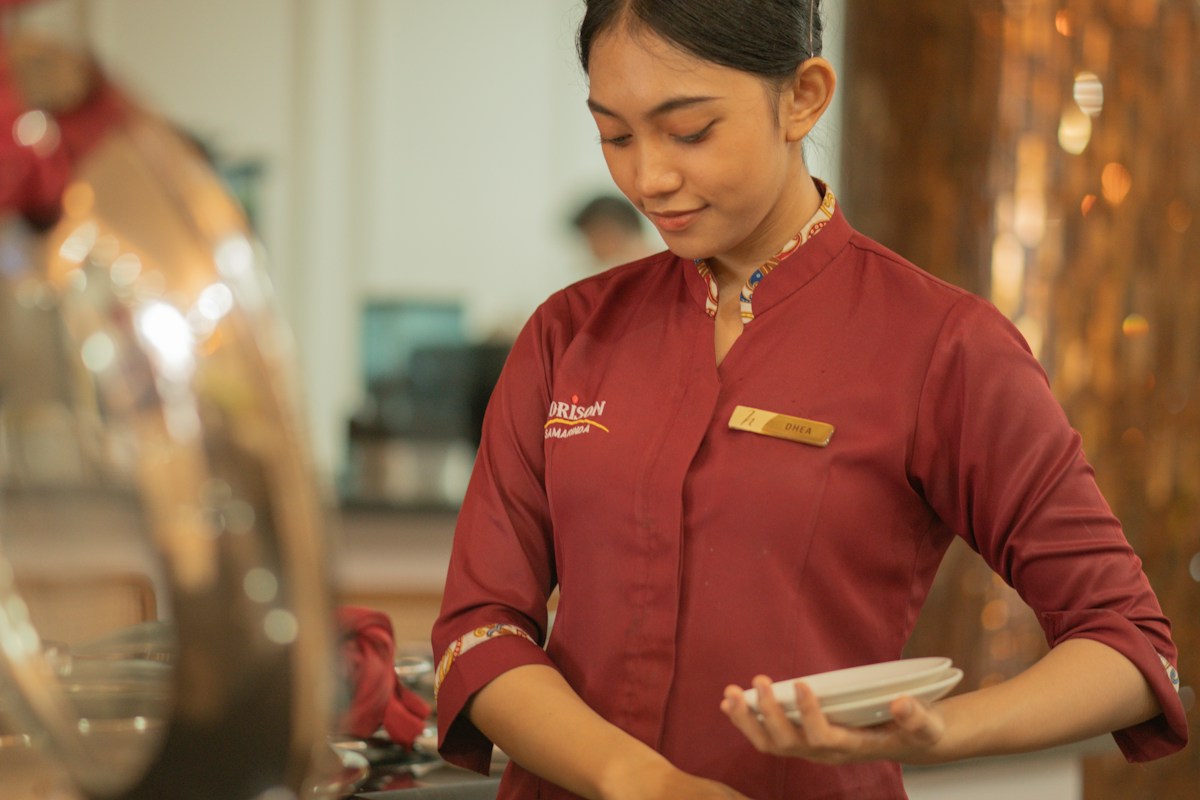
Look at the server in the photo above. She's carrying two side plates back from a breakfast buffet, and in a hotel inside Los Angeles city limits with 60 or more rooms, every minute she spends on that walk now costs at least $25.00 an hour, plus a health payment if the hotel doesn't provide coverage. The plates still need carrying. What changes is how many of her other minutes go to work that a system could do.
That's the whole argument of this piece.
The wage floors are real and they're scheduled. Los Angeles moved its hotel worker minimum to $25.00 on July 1, 2026, with steps to $25.50 in 2027, $28.50 in 2028 and $30.00 on January 1, 2030. San Diego's hospitality ordinance starts lower and climbs to $25.00 by 2030. New York's new union contract goes much further. Waikiki's union hotels added another raise on January 1. If you own or run a hotel in one of those markets, your 2027 budget is already carrying the increase whether you've modeled it or not.
The usual response is a hiring freeze and a lot of overtime. I'd rather rebuild the labor model one department at a time, with three specific systems doing the heavy lifting: AI demand forecasting that sets the schedule, task-based routing in housekeeping, and an AI voice and messaging agent that takes the front desk and reservations call volume. Below is where each one saves real hours, where it doesn't, and what the staffing model looks like afterward.
The Problem: The Floor Moves Faster Than the Rate
Start with the floors themselves, because they aren't the same rule in each market. Some are city ordinances with room-count thresholds. Others are union contracts that set the market rate whether or not your property is signatory.
| Market | Rule | Where it stands in 2026 | Where it goes | Who is covered |
|---|---|---|---|---|
| Los Angeles | City hotel worker minimum wage | $25.00 from July 1, 2026, plus a $4.25 hourly health payment | $25.50 (2027), $28.50 (2028), $30.00 (Jan 2030), then CPI | Hotels with 60 or more guest rooms |
| San Diego | City hospitality minimum wage | $19.00 for hotels from July 1, 2026 | Rising each July to $25.00 in 2030, then CPI | Covered hotels, event centers and amusement parks; the original proposal set 150 rooms |
| New York City | Industry-wide union agreement | Eight-year deal ratified in May 2026 | Average raises above 50 percent; room attendants reach six figures by the end | Union hotels, and in practice the market rate |
| Waikiki | UNITE HERE Local 5 contracts | Raises of $1.75 to $4.32 an hour on January 1, 2026 | The 2024 "Waikiki Standard": $10 an hour over four years for non-tipped workers | 14 hotels on the standard |
New York is the outlier. The Hotel and Gaming Trades Council's eight-year agreement puts housekeepers on a path to $60 an hour, with average wage increases above 50 percent over the life of the contract and the employer health contribution rising from 27.25 to 30.25 percent of payroll. The Los Angeles numbers look modest next to that. They're still a $2.50 jump in one year on the hours that sit closest to the floor.
San Diego is the slow version. The city's hotel rate is $19.00 from July 2026, reaching $25.00 in July 2030. The city's own budget analyst found non-tipped hotel workers already paid anywhere from $17.25 to $30.00 an hour, with labor running 24 to 50 percent of hotel costs. That spread matters. A floor doesn't just lift the people below it; it squeezes everyone just above it, who will reasonably ask why the gap closed.
And the floors land on a cost base that was already moving the wrong way. HotelData.com's analysis of Actabl data from about 5,000 U.S. hotels found wage cost per occupied room rose 12.8 percent in 2025, to $48.32, with a 21.1 percent jump in the fourth quarter alone. Labor cost per hour was up 8 percent. Revenue didn't keep pace.
The Data: Hours Already Fell. The Easy Ones Are Gone.
Here's what makes this harder than it sounds. Hotels have been cutting hours since the pandemic, mostly by not refilling positions. CBRE's 2025 Trends survey found that since 2019 the hours worked at the typical hotel are down 7.4 percent while compensation dollars are up 22.1 percent. In 2024 alone, salaries, wages and benefits rose 4.8 percent against total revenue growth of 2.3 percent.
So the slack that existed in 2019 has mostly been taken. What's left is the structure of the work.
Actabl's own 2025 report shows operators still found efficiency. From January to September, hours per occupied room fell 13.5 percent in guest services, 7.1 percent in housekeeping and 14.6 percent in management, and minutes per occupied room were down 9 percent overall. Those are real gains. They're also the kind you get once, from tightening schedules and cross-training, and they don't repeat on their own.
| Measure | Value | What it tells you |
|---|---|---|
| Hours per occupied room, extended stay | 1.30 | The floor case: limited service, light F&B |
| Hours per occupied room, select service | 1.44 | Front desk and housekeeping dominate |
| Hours per occupied room, full service | 2.57 | F&B and guest services nearly double the load |
| Hours per occupied room, resorts | 4.48 | Recreation, outlets and grounds |
| Guest services HPOR change, Jan to Sep 2025 | -13.5% | Largest department gain; much of it call and desk work |
| Housekeeping HPOR change, Jan to Sep 2025 | -7.1% | Real, smaller, and harder to repeat |
| Management HPOR change, Jan to Sep 2025 | -14.6% | Fewer managers covering more ground |
Read that table as a map of where a floor hurts. A full-service hotel at 2.57 hours per occupied room feels a $2.50 increase nearly twice as hard per room as a select-service hotel at 1.44. A resort feels it three times as hard.
The Framework: Sort Every Hour Into Three Buckets
Before any software, go department by department and sort the scheduled hours into three buckets.
The first bucket is hours that exist because of demand you didn't predict. A server scheduled for a breakfast that ran at 60 covers instead of 110. A second front desk agent on a Tuesday afternoon when arrivals came in late. These are forecasting hours, and a better forecast removes them without anyone working harder.
The second is hours spent on routing and coordination: walking to the wrong floor, waiting on room status, calling the desk to ask what's next, radioing engineering. These are information hours. Better information removes them.
The third is hours of repetitive conversation. Most of the front desk phone, a large share of reservations, the same twenty questions on WhatsApp. These are the hours an AI agent can actually take.
Everything else is the work itself: cleaning the room, carrying the plates, fixing the leak, greeting the guest who walks in. I don't automate that bucket, and I'd be suspicious of any vendor who says they can at these wage levels.
The Mechanism: Three Systems, Wired Into One Schedule
1. AI demand forecasting that writes the schedule
The labor forecast in most hotels is a spreadsheet built from the revenue forecast, adjusted by a manager's memory. An AI forecasting model does the same job at a finer grain: it reads the PMS on-the-books by day and hour, the arrival and departure pattern, group pickup, outlet POS covers by daypart, flight and event data where it matters, and weather for resorts. It produces expected workload per department per hour, then converts that into required labor using your own standards: rooms per attendant, transactions per desk agent, covers per server.
The output is a draft schedule built to demand, published to staff phones, with a variance alert when actual occupancy or covers move. The manager still approves it. What changes is that the schedule starts from the forecast instead of last week's schedule.
Where it pays most is the edges of the day: the breakfast ramp, the late-afternoon arrival wave, the slow middle of a weekday. Those are exactly the shifts that get padded "just in case" when hours were cheap.
2. Task-based routing in housekeeping
We covered this in detail in yesterday's piece on housekeeping task routing. The short version: replace the floor-block sheet with a minute credit for each room based on its state (departure, stayover, long-stay checkout), a live sequence on each attendant's phone fed by PMS room status and the arrival list, and inspections aimed at risk instead of every room. The best-documented single result is a 7.4 percent cut in minutes per occupied room from splitting checkout and stayover credits, with quality unchanged. A realistic range for the full router is 5 to 15 percent.
Housekeeping is usually the largest block of hourly hours in a hotel, so even the low end matters more here than a big percentage anywhere else.
3. An AI agent on the phone and in messaging
This is the one that moved fastest in 2026, and the one with the best hard data. HelloShift published 15 months of calls answered by its AI voice agent across hotel properties: about 75 percent were handled without a transfer to a person, and roughly 72 percent were resolved. About one in four calls came outside 8am to 6pm. Another quarter of all inbound calls were hang-ups, wrong numbers and pocket dials that a human used to pick up anyway.
The topic mix is the useful part, because it tells you which hours come back to the desk.
| Why guests call | Share of calls | Can an AI agent take it? |
|---|---|---|
| Want to reach a person | ~27% | Partly: many resolve once the agent answers the underlying question |
| In-stay requests (housekeeping, maintenance, access) | ~19% | Yes for logging and routing; the fix itself is human |
| Servicing an existing reservation | ~17% | Mostly, with PMS write access |
| New booking or availability | ~14% | Yes, with booking engine integration |
| Property questions (amenities, hours, pets, rates) | ~14% | Yes |
| Directions or transportation | ~4% | Yes |
| Billing or payments | ~4% | Rarely; keep a person on disputes |
On reservations, the larger resort operators have the clearest numbers. PolyAI reports that Golden Nugget automated 87 percent of PBX operator calls and 34 percent of reservation calls, averaging more than 300 completed reservations a week within two months of launch. That's vendor data and I'd treat it as the high end. It's still a useful bracket: PBX is mostly automatable, reservations about a third.
The mechanism matters more than the brand. The agent needs read and write access to the PMS for reservation changes, a live connection to the booking engine for new bookings, a ticket feed into housekeeping and engineering for in-stay requests, and a clean handoff to a person with the transcript attached. Without the write access, you've bought an answering machine that sounds nicer.
Department by Department: What Automates and What Doesn't
This is the table I'd want in front of me before a budget meeting. The hours-saved ranges are my planning estimates built from the sources above; confirm each against a month of your own data before you put it in a forecast.
| Department | Automates | Stays human | System | Realistic hours saved |
|---|---|---|---|---|
| Front office, PBX, reservations | Routine calls, FAQs, reservation changes, after-hours coverage | Arrival welcome, disputes, VIPs, problem stays | AI voice and messaging agent | 20 to 35% |
| Housekeeping | Assignment, sequencing, status updates, inspection lists | Cleaning, laundry handling, deep cleans | Task router with minute credits | 5 to 15% |
| Food and beverage | Shift sizing by daypart, prep quantities | Service, cooking, banquets | Covers forecast feeding the schedule | 2 to 5% |
| Engineering | Work order intake, triage, preventive scheduling | The repair | Ticketing fed by the guest agent | 3 to 8% |
| Bell, security, laundry | Very little | Nearly all of it | Forecast-based scheduling only | 0 to 2% |
The front office number looks big. It's big because the phone is the most automatable work in the building, and it's a smaller department. Housekeeping's percentage is lower and the hours are larger. F&B is where I'd lower expectations most: the gains come from not overstaffing a slow breakfast, and that's about forecasting, not machines.
The Model: One Full-Service Hotel Under a $25 Floor
To make this concrete, here's an illustrative model. It's a 250-room full-service hotel in Los Angeles running 80 percent occupancy, so about 73,000 occupied rooms a year. At Actabl's 2.57 full-service average that's roughly 187,600 labor hours, of which I've assumed 160,000 are hourly non-management hours. These are assumptions for the example, not a specific property.
| Department | Hourly HPOR before | Hourly HPOR after | Hours saved per year |
|---|---|---|---|
| Housekeeping (8%) | 0.96 | 0.88 | 5,600 |
| Front office, PBX and reservations (25%) | 0.33 | 0.25 | 6,000 |
| Food and beverage (3%) | 0.60 | 0.58 | 1,320 |
| Engineering (5%) | 0.14 | 0.13 | 500 |
| Bell, security and laundry (0%) | 0.16 | 0.16 | 0 |
| Total | 2.19 | 2.01 | 13,420 (about 8.4%) |
Now price the floor against it. Assume 60 percent of those hourly hours sit at or near the old $22.50 rate and take the full $2.50 increase, and the remaining 40 percent get a $1.00 compression raise to keep some gap. That's about $304,000 in wages, or roughly $365,000 with 20 percent for payroll taxes and benefits. I've left out the $4.25 health payment on the assumption the hotel already provides coverage; if it doesn't, the number gets much bigger.
| Line | No redesign | Redesign at 4% | Redesign at 8.4% | Redesign at 12% |
|---|---|---|---|---|
| Wage floor cost increase (loaded) | $365,000 | $365,000 | $365,000 | $365,000 |
| Hourly hours removed | 0 | 6,400 | 13,420 | 19,200 |
| Labor saved at $31 loaded | $0 | $198,400 | $416,000 | $595,200 |
| Technology cost | $0 | $90,000 | $90,000 | $90,000 |
| Net change in labor plus tech cost | +$365,000 | +$256,600 | +$39,000 | -$140,200 |
At the middle case, the redesign absorbs almost all of the July 2026 step. That's the realistic headline. It doesn't absorb the 2028 step to $28.50, and nothing here pays for the jump to $30.00 in 2030 on its own. Those will come out of rate, out of mix, or out of margin.
Thirteen thousand hours is about six and a half full-time positions. I wouldn't plan to lay anyone off to get them. Hotels lose people every year; the redesign is what lets you not refill some of those seats, and stop paying overtime to cover the gaps you couldn't fill anyway.
The Staffing Model That Results
The org chart after a redesign looks a little different, and it's worth being honest with the team about how.
The front desk gets smaller and more senior. Fewer agents answering phones, more time at the counter, and one person per shift who owns the escalations the AI agent hands over. I'd pay that person above the floor on purpose. When I ran sales strategy and operations at Starwood across more than 800 hotels, the properties that held service scores through staffing cuts were the ones that kept someone on every shift with the authority to fix a problem on the spot.
Housekeeping keeps its headcount close to flat and finishes the day more evenly. The supervisor role shifts from walking every room to working the exception list.
F&B schedules shrink at the edges of each meal period. The core service team stays.
A new job appears, usually part of someone's existing role: whoever owns the forecast and the agent. They review the weekly variance between forecast and actual, check the agent's transfer log, and fix the scripts. At our ten Collective Retreats locations, before the business was acquired in 2025, every system we rolled out without a named owner on site drifted within a quarter. That's still true.
Implementation: Six Months, In This Order
Month one is baseline. Pull a year of hours by department from payroll and occupied rooms from the PMS. Pull call volume and call reasons from the phone system, and if you can't get reasons, sample 200 calls by hand. Time a month of room cleans. Without this, you won't know whether anything worked.
Months two and three, the phone. It's the fastest payback and the easiest to measure. Start with PBX and after-hours, then add reservation changes once the PMS write access is tested. Track containment, transfers and complaints weekly, and listen to twenty recordings every Friday.
Months three and four, housekeeping credits and routing, following the sequence in the task routing piece.
Months four through six, forecasting into the schedule. This one depends on the first two, because the agent and the router generate the workload data the forecast needs. Run the AI-drafted schedule beside the manager's schedule for four weeks before you switch. Wage-floor ordinances also tend to come with scheduling and training rules (Los Angeles added a training requirement), so build compliance checks into the scheduling tool rather than a binder.
If the forecast is the piece you're missing, it's the core of our AI revenue optimization and forecasting work, since the same demand model that sets rates should be setting hours.
One caution. Don't announce this as a cost program. Tell the team the floor is coming, the hotel is paying it, and the systems are how it pays it without cutting their hours. In my experience that's also the truth.
Frequently Asked Questions
What is the hotel worker minimum wage in Los Angeles in 2026?
For hotels in the City of Los Angeles with 60 or more guest rooms, the minimum is $25.00 an hour from July 1, 2026, plus a $4.25 hourly health benefit payment where the hotel does not provide coverage. Under the May 2026 amendment it rises to $25.50 in July 2027, $28.50 in July 2028 and $30.00 on January 1, 2030, then adjusts with CPI.
How much labor can AI realistically save a hotel?
Across a full-service hotel, a realistic planning range is about 5 to 12 percent of hourly hours, with most of the savings in the front office and housekeeping. Front desk, PBX and reservations can see 20 to 35 percent as an AI agent takes routine calls; housekeeping routing typically recovers 5 to 15 percent of cleaning minutes; F&B gains are smaller and come mainly from better forecasting.
Which hotel jobs are not automatable?
Cleaning rooms, cooking, serving guests, banquet work, bell service, security and the actual repair in engineering. AI removes the coordination, scheduling and routine conversation around those jobs. It does not replace the physical work, and hotels should plan around that.
How many hotel calls can an AI voice agent handle?
Published vendor data puts it at around three quarters of calls handled without a transfer to a person, with roughly 72 percent resolved, based on 15 months of HelloShift calls. Reservation calls automate less: Golden Nugget reported 34 percent of reservation calls automated against 87 percent of PBX operator calls.
Will a labor redesign fully offset a $25 wage floor?
In an illustrative 250-room full-service model, an 8 percent reduction in hourly hours covers most of the first $2.50 step after technology costs. It does not cover later steps to $28.50 and $30.00. Those require pricing, mix and margin decisions alongside the labor model.
Rebuilding a labor model around a wage floor is the kind of project AI for Hoteliers exists for: we baseline your hours, wire the phone agent, routing and forecast into the systems you already run, and track the hours that actually come out. I owned ten hotels, so I'd start with the department where your floor hits hardest. If that's useful, book a free 15-minute call.
Peter Mack is a hospitality technology strategist and founder of HospitalityOS, helping independent hotels and resorts implement AI systems that drive revenue and reduce operational costs. With 25 years in hospitality operations and technology, he has worked with properties of all types and in every region as both a General Manager, Founder, Operator, Asset Manager, and Owner.