Housekeeping Is the Hardest Role to Fill: Task Routing and Realistic Productivity Gains
Housekeeping is the job hotels can least afford to leave open and the one they find hardest to fill. Pay is up by almost a third since 2020 and headcount hasn't moved. The minutes have to come from how the day is assigned: credits that price each room by what it needs, a router fed by live room status, and inspections aimed where the risk is.
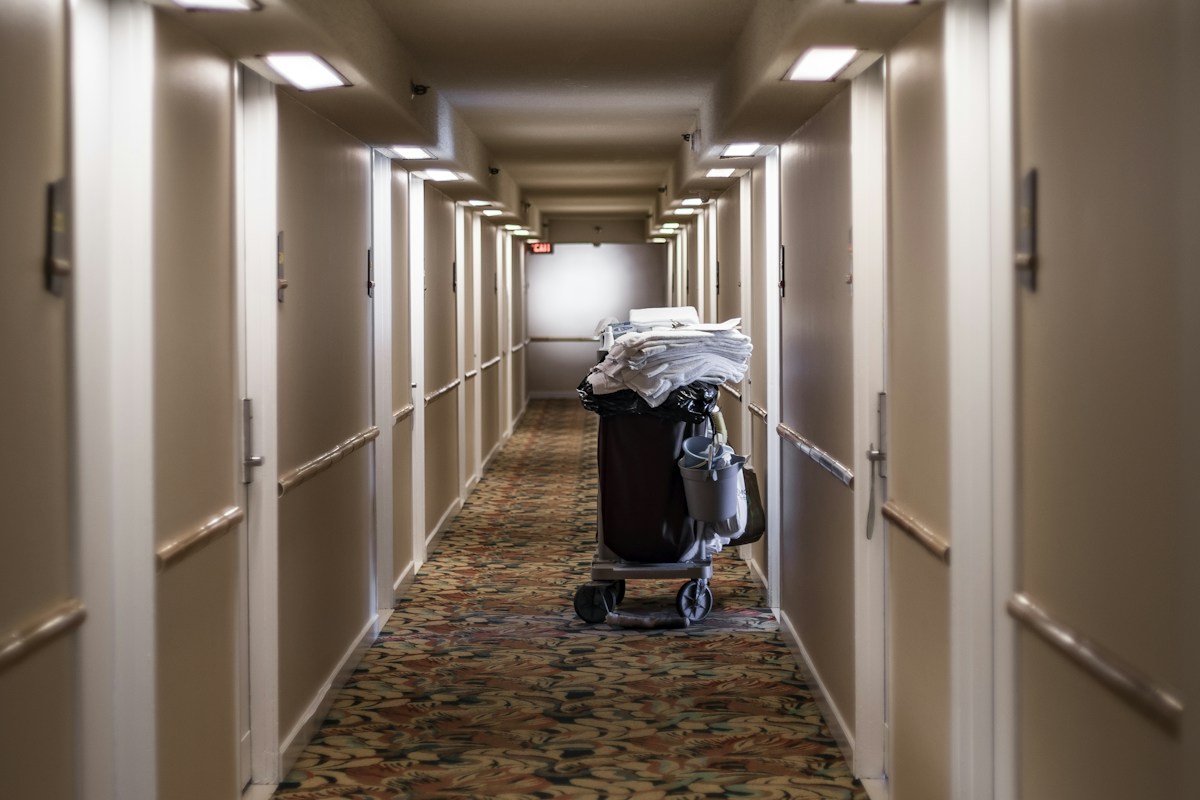
The housekeeping cart in the photo above is parked outside one door, which means somebody is inside that room, and the room next to it has a guest standing in the lobby asking when it'll be ready. Nobody in the lobby knows which of those two rooms the attendant will do first. Usually the attendant doesn't either. She's working the sheet she was handed at 8:15, in the order it was printed.
That sheet is the problem I keep coming back to.
Housekeeping is the hardest hotel job to fill. AHLA's survey of 282 hoteliers, run with Hireology over the 2024 holidays, found 65 percent of hotels still short-staffed, and housekeeping was the most-mentioned shortage at 38 percent. The usual answer has been to pay more, and pay has gone up. What hasn't changed much is how the work gets handed out. Most departments still assign rooms in floor blocks at the start of the shift and then spend the day reacting by radio.
This piece is about the layer between the PMS and the attendant's phone: mobile task routing fed by live room status, with credits that price each room by what it actually needs and inspections that go where the risk is. It's the cheapest productivity lever in the rooms division. It's also the one most often oversold, so the second half is about honest ranges.
The Problem: A Shortage You Can't Hire Your Way Out Of
Start with the labor market, because it sets the ceiling on everything else. OysterLink's read of Bureau of Labor Statistics data put average housekeeper pay at $36,880 in 2024, up 29 percent since 2020, while total employment in the occupation rose only 1.6 percent to about 781,000. Wages up by almost a third, headcount flat. That's a market telling you the people aren't there at any reasonable price.
Hotels are the biggest employer in that occupation. The BLS counted 397,640 maids and housekeeping cleaners in traveler accommodation in May 2023, at a mean of $16.28 an hour, and they made up about 21 percent of all employment in the industry. One in five hotel workers, in the role hardest to replace.
| Measure | Result | Prior reading |
|---|---|---|
| Hotels reporting staffing shortages | 65% | 76% (May 2024) |
| Severely understaffed | 9% | 13% (May 2024) |
| Hotels with openings they could not fill | 71% | 79% (June 2024, per Hotel Dive) |
| Most-mentioned shortage: housekeeping | 38% | n/a |
| Front desk | 26% | n/a |
| Culinary | 14% | n/a |
| Maintenance | 13% | n/a |
The numbers improved from 2024 and the shortage didn't go away. AHLA's March 2026 survey of 246 owners and operators still found more than half of properties somewhat or severely understaffed, with 70 percent using higher wages to recruit and keep people and 65 percent naming labor cost as a financial pressure. Hotel Dive's write-up of the earlier survey put the average hotel at six to seven open positions at a time.
And the work itself got heavier. When hotels dropped automatic daily cleaning after 2020, the rooms that do get cleaned are dirtier on average. The AP reported in 2022 that the Oakland Marriott City Center had cut a housekeeping shift from 25 people to 12, and quoted a housekeeper on what five days without service does to a bathroom. A Hilton Hawaiian Village housekeeper told UNITE HERE Local 5 that a checkout room used to take 45 minutes and now took more than an hour. That's one person's account and a union's framing. It still matches what every executive housekeeper will tell you about a long-stay checkout.
So a department that's short on people is also cleaning rooms that vary far more than they used to. A flat quota of fourteen or fifteen rooms a shift was always crude. Now it's wrong most days.
Wages up by almost a third, headcount flat. The people aren't there at any reasonable price, so the minutes have to come from somewhere else.
The Data: What a Room Actually Takes
There's no clean, public benchmark of minutes per room by hotel tier. Brands have internal standards and they don't publish them. What does exist is a handful of measurements that point the same way, and the spread between them is the useful part.
| Room state or measure | Minutes | Source and basis |
|---|---|---|
| Departure room, time-and-motion study | About 43 | CleanLink, study summary |
| Stayover room, same study | About 23 | Derived: "nearly 20 minutes" less than a departure |
| Departure room, industry benchmark | 25 to 35 | HelloShift Hotel Operations Index |
| Median clean, typical property on the platform | About 31 | HelloShift, vendor data |
| Credit used in a controlled test: checkout / stayover | 30 / 20 | Actabl, two-hotel test |
| Long-stay checkout after skipped service | 60 or more | One housekeeper's account, UNITE HERE Local 5 |
Two things jump out. The gap between a departure and a stayover is close to twofold. And the rooms that skipped service for several days sit outside both numbers.
Now look at how most hotels assign the day. A flat quota treats a 23-minute stayover and a 60-minute five-night checkout as the same unit of work. The attendant who draws a floor of checkouts finishes late and gets the overtime or the write-up; the one who draws stayovers finishes early and gets sent to help, after walking two floors. Larry Mogelonsky's simple arithmetic in Hotel Online makes the stakes plain: at 3,000 occupied room nights a month, every two minutes shaved off the average room is about 100 labor hours a month.
The other hidden time is rooms you can't get into. HelloShift's operations index found 8.3 percent of scheduled room visits hit a do-not-disturb sign or a declined service. On a 120-room board that's ten knocks a day that produce nothing, each one followed by a decision about when to come back. Paper can't make that decision. Neither can a radio.
The Framework: Price Every Room, Then Route the Day
At Starwood I ran sales strategy and operations across more than 800 hotels, and the lesson that stuck from that job applies directly here. You can't manage a unit you haven't priced. Revenue managers stopped selling "a room" decades ago; they sell a room type, on a date, through a channel, at a rate. Housekeeping still mostly schedules "a room."
The fix has two parts. First, give every room on today's board a credit in minutes that reflects what it actually needs. Second, sequence and assign those credits continuously through the day, against live status, instead of once at 8:15.
Credits come from a short list of attributes the PMS already holds.
| Room attribute | Where the data lives | Starting credit | Routing effect |
|---|---|---|---|
| Departure, 1 to 2 nights | PMS reservation | 30 to 35 min | Released when the guest checks out |
| Departure, 4+ nights with service skipped | PMS stay length plus service log | 45 to 60 min | Assigned early to a senior attendant |
| Stayover, full service | PMS in-house list | 20 to 23 min | Slotted after arrivals are covered |
| Stayover, light touch (towels and trash) | Guest opt-out preference | 8 to 12 min | Batched by floor |
| Due-in with early arrival or VIP flag | PMS arrival, ETA, guest notes | Base plus priority | Jumps the queue; inspection required |
Once rooms carry credits, an attendant's day is a budget of minutes instead of a count of doors. Seven and a half hours of cleaning time is 450 minutes. The router fills it with whatever mix of rooms the house needs, and two attendants with very different boards end the shift with roughly the same load.
Sequencing is the second half. The order of the board should come from the front desk, not the floor plan. A due-in at 1 p.m. with a confirmed early arrival outranks a stayover on the same floor. A checkout that hasn't happened yet shouldn't be on anyone's list. A room flagged DND at 10 should come back into the queue at a set time, with a guest message sent from the PMS, rather than sit in limbo until the attendant remembers it at 2:30.
Revenue managers stopped selling "a room" decades ago. Housekeeping still schedules one.
The Mechanism: A Housekeeping Task Router
None of this is exotic software. Most of it exists in housekeeping platforms already on the market, and the integration points are standard. What separates a working system from an app that attendants ignore is how the pieces are wired. There are five.
1. A live room-status feed. The router subscribes to the PMS for check-outs, check-ins, room moves, ETAs and service preferences, two-way. When the attendant marks a room clean on her phone, the PMS sees it in seconds and the front desk can sell it. When a guest checks out at the kiosk, the room appears on someone's list without a call to the housekeeping office. If your PMS integration only syncs every fifteen minutes or only in one direction, fix that first; everything downstream depends on it.
2. A credit engine. Every morning, and again whenever status changes, the engine prices each room using the attributes in the table above. It learns. Every clean the attendant starts and finishes on the phone is a timestamp pair, and after a month the engine knows that your corner kings take seven minutes longer than your standard doubles and that the third floor's tubs add time. Actabl's two-hotel test is the cleanest evidence that even crude credits help: moving one property from a flat 28-minute standard to 30 for checkouts and 20 for stayovers took minutes per occupied room from 28.2 to 26.1 over four months, while the control hotel stayed flat and neither saw any material change in quality scores.
3. A sequencing and assignment model. This is where the AI earns its place. The model takes the priced rooms, the attendants on shift and their skills, the arrival list with ETAs, and the physical layout, and produces an ordered list per person. It rebalances during the day. When an attendant falls behind, the next released checkout goes to someone with slack on the same floor, instead of to whoever answers the radio. Travel time is a real input here. In a tower it's elevator waits; in a resort or a campus of separate buildings, walking between units can eat a meaningful slice of the shift, and a router that ignores distance will build lists nobody can finish.
4. Inspection by exception. Inspecting every room is a habit left over from a time when supervisors had nothing else to go on. HelloShift's data shows inspections failing on 3 to 4 percent of runs. When most rooms pass, a 100 percent inspection standard mostly checks rooms that were fine. The router decides which rooms get inspected: every VIP and early arrival, every room cleaned by an attendant in her first month, every room whose clean time came in far under its credit, plus a random sample of the rest. The supervisor walks fewer doors and finds more problems.
5. Work orders and supplies on the same rail. When an attendant finds a dripping faucet, she photographs it from the room's task card and maintenance gets a ticket tied to the room. The room's status reflects it, so the desk doesn't sell it if it's out of order. Par levels on the cart get the same treatment. A short message from the floor ("out of king sheets, fourth floor") should create a task for the linen runner, not a phone call to the office.
The attendant sees none of this machinery. She sees one list on her phone, in the right order, with the next room's notes on it, in her own language. That last part matters more than vendors admit. A routing app that only runs in English will lose half the department in most US cities.
| Capability | Paper board and radio | Basic housekeeping app | Task router with credits |
|---|---|---|---|
| Room status reaches the desk | By phone call | When the attendant taps clean | When tapped, and inspection status shown |
| Workload per attendant | Room count | Room count | Minutes, from learned credits |
| Order of rooms | Floor plan | Set at start of shift | Rebalanced against arrivals and ETAs |
| DND and declined service | Remembered or not | Logged | Logged, re-queued at a set time, guest messaged |
| Inspections | Every room, or none | Every room | Risk-based list |
What the Evidence Actually Shows
This is where most housekeeping software pitches go wrong, and where owners should be most careful. The published results range from modest and well-measured to large and loosely measured, and they're not the same kind of number.
| Evidence | Reported result | Method | How much weight to give it |
|---|---|---|---|
| Actabl credit test, two hotels | Minutes per occupied room down 7.4% | Four months, control hotel, quality tracked | High: controlled, but only two hotels |
| Actabl customers, H1 2026 | Hours per occupied room down 3.1% full-service, 3.5% select-service | Platform benchmark while occupancy rose | Medium: real data, customers only |
| The Mandala Hotel Berlin, hotelkit | One more room per attendant per day; about 3,000 hours a year | Vendor case study, verified by Hotel Tech Report | Medium: plausible, no baseline published |
| Staycity ApartHotels, Optii | Productivity up 20% or 25%; rooms ready nearly 2 hours sooner | Vendor case study, 45 properties | Low to medium: page gives two different figures |
| AHLA and Actabl workforce report | 15% say AI improved frontline work | Survey of hotel respondents, Nov 2026 | A caution, not a result |
The pattern is consistent enough to plan on. Credit-based assignment on its own is worth something like 5 to 8 percent of room-cleaning minutes. Adding live status, dynamic sequencing and risk-based inspection pushes that toward the 10 to 15 percent range in the better-documented cases, with The Mandala's "one more room per attendant per day" sitting about there for a typical board. The 20 to 25 percent figures in the Staycity case study may well be true for an aparthotel group starting from a weak baseline. I wouldn't put them in an owner's budget.
The AHLA and Actabl number deserves its own line. In the November 2026 report, 84 percent of respondents said AI had improved their own work and only 15 percent said it had improved frontline work. Managers are getting the dashboards; attendants are getting the same sheet on a smaller screen. A task router that's built for the supervisor's convenience will land in that 85 percent.
Here's what a realistic range looks like in dollars for one property.
| Scenario | Cleaning minutes saved | Hours saved per day | Hours per year | Wage value per year |
|---|---|---|---|---|
| Credits only | 5% | 2.7 | About 1,000 | About $16,300 |
| Credits plus live routing | 10% | 5.5 | About 2,000 | About $32,600 |
| Full router with risk-based inspection | 15% | 8.2 | About 3,000 | About $48,900 |
Three thousand hours is about one and a half full-time attendants. For a department carrying six or seven open positions, that's the honest framing. The router doesn't let you cut people. It lets you run the house with the people you can actually hire, and stop paying overtime to cover the ones you can't.
Add the loaded cost of benefits and payroll tax and the high case clears $60,000 a year at most properties. Add the rooms released to the desk earlier, which is where the Staycity "nearly two hours" claim points, and the revenue side starts to matter too. Early check-in fees and fewer walked arrivals are real money. I'd still count them only after you've measured them.
Implementation: Ninety Days From Sheet to Router
Days one to thirty are measurement. Turn on start and finish timestamps in whatever housekeeping app you have, or pilot one on two floors, and leave assignment exactly as it is. You need a month of real clean times by room type and by state before you change anything, or you'll have nothing to compare against. Log DND and declined service separately. Get your PMS vendor to confirm in writing that the status interface is two-way and near real time; if it isn't, that's the first project.
Days thirty-one to sixty, switch to credits. Use your own timed data to set the base minutes for each row of the credit table, not the starting numbers in this article. Keep the paper board as a backup for two weeks. Track minutes per occupied room weekly against the first month, and track your inspection fail rate and room-related guest complaints so you know whether quality moved.
Days sixty-one to ninety, turn on dynamic sequencing and risk-based inspection. Feed the router the arrival list with ETAs and early check-in requests. Define the inspection rules with your executive housekeeper, not for her. Let the supervisors carry phones with the same list the attendants see, because the moment a supervisor starts keeping a private paper copy, the system's status is no longer the truth.
If you're connecting the PMS, the housekeeping app, maintenance ticketing and guest messaging for the first time, that wiring is usually the slowest part. It's the kind of build our custom AI integrations and automations work covers, and it's worth scoping before you sign a housekeeping software contract, since the integration terms decide most of the result.
Two cautions from experience. First, don't use the timestamps to discipline people in the first ninety days. The day attendants believe the app is a stopwatch aimed at them, they'll tap "clean" from the hallway and your data is gone. Use the times to fix credits, not to rank staff. Second, give attendants something visible in return: fewer floors walked, an even finish time, rooms in their own language on the phone. Running ten locations at Collective Retreats, before it was acquired in 2025, made one thing obvious to me. A tool the frontline team doesn't trust gets worked around within a week, no matter what the dashboard says.
The sheet at 8:15 can go. The person reading it can't, and she's the one you're short of.
Frequently Asked Questions
How many minutes should it take to clean a hotel room?
Published figures cluster around 25 to 35 minutes for a departure room and about 20 to 23 minutes for a stayover. One time-and-motion study put a departure at about 43 minutes, nearly 20 minutes longer than a stayover. Long-stay checkouts where service was skipped for several days can run past an hour. The right numbers for your hotel come from a month of your own timed cleans by room type and room state.
What is housekeeping task routing?
Task routing replaces the fixed morning room assignment with a list on each attendant's phone that is ordered and rebalanced through the day. It uses live room status from the PMS, a minute credit for each room based on what it needs, the arrival list with ETAs and early check-in requests, and the layout of the property. Rooms are released to the front desk as soon as they are cleaned and, where required, inspected.
How much can housekeeping software improve productivity?
The best-documented result is a 7.4 percent cut in minutes per occupied room from moving to separate checkout and stayover credits, with no change in quality scores. Vendor case studies report more, from about one extra room per attendant per day to 20 or 25 percent productivity gains. A realistic planning range for a full router with live status and risk-based inspection is 10 to 15 percent of room-cleaning minutes, confirmed against your own baseline.
Do we still need to inspect every room?
Not if inspections are targeted. Platform data shows inspections fail on about 3 to 4 percent of runs, so inspecting every room spends most supervisor time on rooms that pass. A risk-based list covers every VIP and early arrival, rooms cleaned by new attendants, rooms finished well under their credit time, and a random sample of the rest.
Will task routing let us reduce housekeeping headcount?
For most hotels the gain shows up as open positions you no longer have to fill and overtime you no longer pay, not as layoffs. With hotels averaging six to seven open positions and housekeeping the most-cited shortage, a 10 to 15 percent saving in cleaning minutes typically covers one to two full-time roles at a 150-room property.
Peter Mack is a hospitality technology strategist and founder of HospitalityOS, helping independent hotels and resorts implement AI systems that drive revenue and reduce operational costs. With 25 years in hospitality operations and technology, he has worked with properties of all types and in every region as both a General Manager, Founder, Operator, Asset Manager, and Owner.