Does a PIP Move ADR? Evidence, Sequencing, and Scope Negotiation
A brand PIP is a list of things to buy. Some of them change what guests will pay and some of them don't. An owner who mines three years of reviews for physical-product complaints, models the rate lift by scope item from rate-shop and comp-set data, and sequences the work by measured payback walks into the brand conversation with evidence instead of a request for mercy.
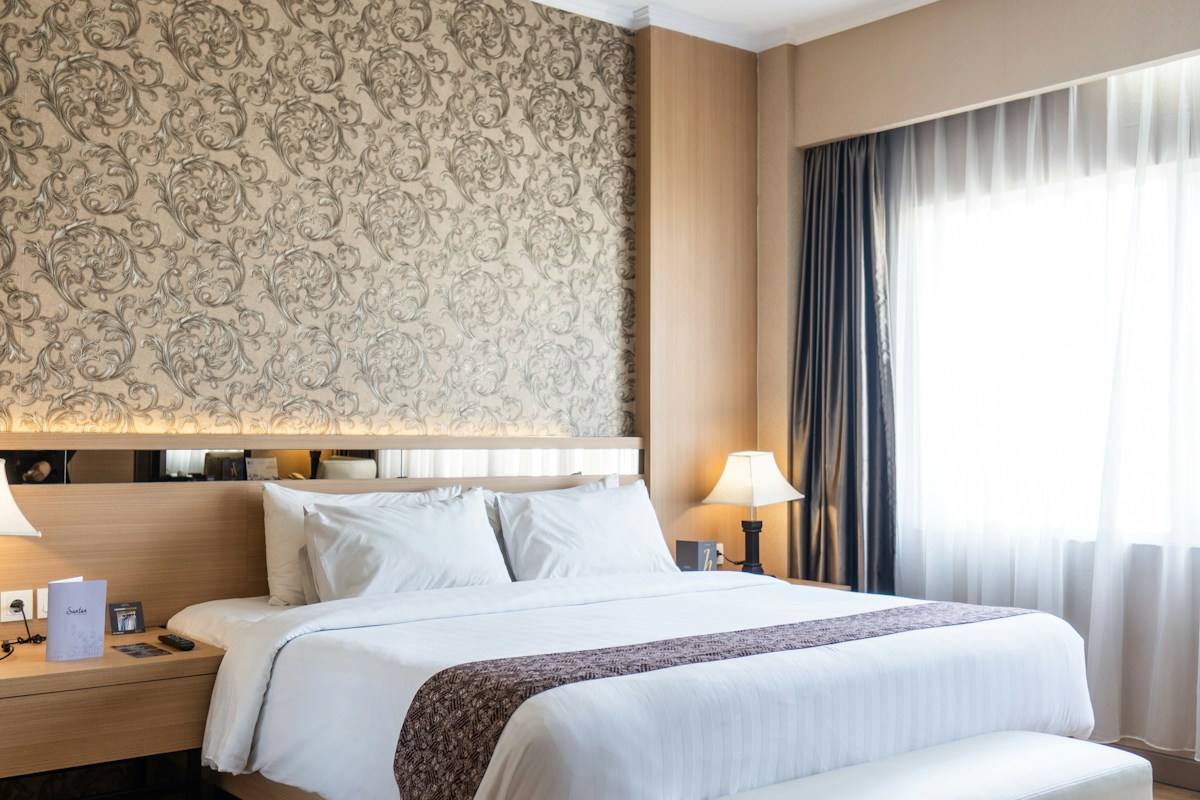
The room in the photo above has a fresh white duvet, crisp pillows and a runner pulled straight across the foot of the bed. Behind it, a full wall of gold damask wallpaper and a band of honey-colored wood paneling that went in a long time ago. A guest sleeps on the bed. A brand inspector photographs the wall.
Which of those two things moves the rate is the question this article is about.
I owned ten hotels. I was also VP of sales strategy and operations at Starwood, a company of more than 800 hotels with brand standards for every surface. So I've seen the PIP from both ends: the company that sets the standard and the owner who writes the check. The brand's list and the guest's list overlap. They are not the same list, and the gap between them is where an owner's money goes to die or gets saved.
Most owners argue that gap with opinion. This piece is about arguing it with data the hotel already has.
The Problem: A PIP Prices Everything the Same
A property improvement plan arrives as a line-item list: replace casegoods, replace carpet, convert tubs, remove textured ceilings, open the closets, refresh the lobby, swap the signage. Each line has a deadline. None of them has an expected return attached, because that isn't the brand's job.
The bill is big and getting bigger. Lee Hunter of Hunter Hotel Advisors put a midmarket PIP at $35,000 to $40,000 per key, and Matthews found PIP costs running more than 30 percent above pre-COVID levels. Hampton's Forever Young program runs $20,000 to $30,000 a room for hotels built in the early 1990s and over $40,000 for 1980s properties. Full-service PIPs are commonly estimated at $50,000 to $150,000 or more per key, and luxury rooms have priced at well over $100,000 a key.
Then there's the timing. A buyer inherits one too. HVS notes that a deferred PIP usually reduces the offer price by more than the stated renovation budget, because buyers price in contractor risk, disruption and brand compliance on top of the cost. Arriba Capital's Ryan Bosch wrote in January that lenders treat a PIP due inside 24 months as part of total project cost, and often require a 5 to 6 percent FF&E reserve when it falls 24 to 36 months out.
Rate is rising on its own, which muddies everything. CoStar and Tourism Economics raised their 2026 forecast in August to 3.1 percent ADR growth, and HVS's October pulse had ADR well above pre-pandemic levels, with luxury and upper-upscale stays pulling the average up. In a market like that, any renovation looks like it worked. The model below controls for market movement for exactly that reason.
So the PIP touches the loan, the sale price and the next decade of the P&L. And the usual way to decide what's in it is a walk-through with the brand's PIP writer and a negotiation built on how the owner feels about the wallpaper.
| Program or segment | Published PIP cost per key | Source |
|---|---|---|
| Holiday Inn Express, Formula Blue 2.2 | $10,000 to $25,000 | Matthews |
| Hampton, Forever Young (built 1990 to 1995) | $20,000 to $30,000 | Matthews |
| Hampton, Forever Young (1980s builds) | Over $40,000 | Matthews |
| Typical midmarket PIP | $35,000 to $40,000 | Hunter Hotel Advisors |
| Full-service PIP | $50,000 to $150,000+ | Industry estimates via Peony |
| Tub-to-shower conversion alone | $20,000+ added | Rauch, Hotel Online |
The Data: What Actually Moves Rate
The evidence that renovation lifts performance is real and thin. Hotel & Leisure Advisors tracked one urban focused-service hotel through a $9 million renovation and found NOI about 33 percent higher in the year after completion, with its TripAdvisor rating up 0.2 points on a five-point scale. That's one hotel. Robert Rauch, writing in July, described renovated hotels earning a real ADR premium over tired comp-set competitors within a year or two, and named what he thinks drives it: new TVs, well-lit bathroom mirrors, paint, carpet and beds that don't sag. His 120-key renovation came in around $25,000 a key, funded from the 4 percent reserve. A similar hotel spent more than $5.5 million, partly on tub-to-shower conversions that added over $20,000 a key and, in his view, rarely pay back.
The better-measured link runs through reviews. Chris Anderson at Cornell found that a one-point gain on a 100-point review index was associated with up to 0.89 percent higher ADR, 0.54 percent higher occupancy and 1.42 percent higher RevPAR. Cornell research is also cited for an estimate that a one-point rise on a five-point OTA scale let a hotel raise price 11.2 percent without losing occupancy.
That chain is the whole method. Physical product shows up in reviews. Reviews show up in pricing power. If a PIP item doesn't fix something guests complain about, or something comp-set guests praise, its route to ADR is weak.
Some of it is obvious. Guests write about mattresses, shower pressure, bathroom lighting, worn carpet, outlets by the bed and noisy PTACs. They almost never write about whether the closet has a door. CHMWarnick and HotelAVE told CoStar that owners rarely resist mattresses, TVs and bathrooms, and do push back on open-closet designs and stucco ceiling removal. Guests seem to agree with the owners.
The Framework: Three Questions Before the Check
Every line in the PIP gets three questions.
Does it fix a measured complaint? Count how often guests mention the thing, how negative they are, and how that compares to the comp set's guests. This is a review-mining job.
What would it do to rate? Look at what happened to the rate position of comp-set hotels that already did the same work, and at how the hotel's own rate responds when its review score moves. This is a rate-modeling job.
When should it happen? Weigh cost against modeled lift, then schedule the work into the weeks where rooms out of order cost the least. This is a sequencing job.
The output is a scored PIP: every line with an evidence grade, a modeled lift, a payback and a proposed date. That document is what goes to the brand.
The Mechanism, Part 1: Mining Reviews for Physical-Product Drag
Pull every review the hotel has collected for three years: Google, TripAdvisor, Booking.com, Expedia and the brand's own post-stay survey. A few thousand reviews is typical for a select-service hotel. Do the same for four or five comp-set hotels from public sites.
Run them through aspect-based sentiment analysis. The model splits each review into individual opinions and tags each one to an aspect and a sentiment. Commercial tools already do this at scale; TrustYou's SentimentAI, for example, sorts comments into more than 700 categories in 23 languages. For PIP work the taxonomy has to be cut finer than the vendor default, down to the level of a PIP line: mattress, pillows, bathroom lighting, shower, vanity, tub, carpet, wallcovering, drapes, casegoods, closet, HVAC, outlets and USB, TV, corridor, lobby, fitness room.
Condition and cleanliness are where guests start reading. A Trivago survey cited by Hotel Business found 86 percent of consumers look for cleanliness first in reviews before booking, and guests expect linens, carpet, furniture and fixtures to look close to new.
Three things make the output usable.
Separate condition from cleanliness. "Stained carpet" is housekeeping until the same carpet shows up as "worn" and "old" across hundreds of reviews. The classifier needs both labels, and a person spot-checks a sample of each before anyone believes the totals.
Normalize per 100 reviews and benchmark. Raw counts mean nothing without the comp set beside them. A hotel with 6 mattress complaints per 100 reviews against a comp-set median of 2 has a mattress problem; one at 2 against 2 doesn't.
Tie to rooms where you can. Post-stay surveys usually carry a room number. Mapping complaints to rooms often shows the problem is one floor or one room type, which turns a property-wide line into a partial one.
We covered the general mechanics in our piece on AI sentiment analysis. The PIP version is narrower and more useful, because every aspect maps to a dollar figure on the brand's list.
| Aspect | Subject hotel | Comp-set median | Gap | PIP line it maps to |
|---|---|---|---|---|
| Mattress and bed comfort | 6.1 | 2.2 | +3.9 | Bedding package |
| Bathroom lighting and vanity | 4.4 | 1.8 | +2.6 | Bathroom refresh |
| Worn carpet, dated decor | 3.7 | 1.5 | +2.2 | Soft goods |
| Shower pressure and tub | 1.9 | 1.7 | +0.2 | Tub-to-shower conversion |
| Furniture condition | 0.9 | 0.8 | +0.1 | Casegoods replacement |
| Closet design, ceiling texture | 0.1 | 0.1 | 0.0 | Open closet, ceiling work |
Read the bottom three rows carefully. They carry most of the cost in a typical PIP and almost none of the complaint gap.
The Mechanism, Part 2: Modeling the ADR Lift by Scope Item
Reviews say what bothers guests. Rate data says what fixing it is worth.
Start with the rate-shop history the revenue team already pays for: two or three years of daily shopped rates for the hotel and its comp set by room type and length of stay, plus monthly STR or CoStar index reports. Our rate intelligence piece covers the collection side.
Then find the natural experiments. Somewhere in most comp sets, a hotel renovated in the last few years. The model lines up that hotel's rate premium over the rest of the set for twelve months before the work and twelve months after, by room type, and controls for market-wide movement. Two or three of those give a defensible range for what a renovation did to rate position in this specific market. They also show how long the premium took to arrive.
Next, the hotel's own elasticity. Using the review-score series and the hotel's ADR index over the same years, estimate how much rate moved when the score moved. The Cornell coefficients are the sanity check; the hotel's own history is the number you use.
Finally, allocate. Each scope item gets a share of the modeled lift in proportion to the complaint gap it closes, with the comp-set renovations bounding the total. The output is a modeled ADR lift per item, with a range, by room type. A suite that guests already rate well gets less lift from new soft goods than a standard king that draws the mattress complaints.
None of this is precise. It's a model, and it should show its ranges. It's still far better than the alternative, which is assuming every dollar of PIP is equally productive.
| PIP scope item | Cost (cost per key) | Modeled ADR lift | Annual NOI lift | Payback |
|---|---|---|---|---|
| Mattresses, bedding, pillows | $216,000 ($1,800) | +$2.50 | $62,200 | 3.5 years |
| Bathroom lighting, fixtures, vanity | $780,000 ($6,500) | +$4.00 | $99,500 | 7.8 years |
| Carpet, drapes, wallcovering, paint | $660,000 ($5,500) | +$3.00 | $74,600 | 8.8 years |
| Lobby and public-space refresh | $450,000 ($3,750) | +$1.50 | $37,300 | 12.1 years |
| Open closets, ceiling texture removal | $180,000 ($1,500) | +$0.25 | $6,200 | 28.9 years |
| Casegoods replaced while functional | $840,000 ($7,000) | +$0.75 | $18,700 | 45.0 years |
| Tub-to-shower conversion | $2,400,000 ($20,000) | +$2.00 | $49,800 | 48.2 years |
The full list in this example costs $5.5 million, about $46,000 a key. The first four rows cost $2.1 million, 38 percent of the total, and carry $11 of the $14 in modeled ADR lift. That's 79 percent of the rate benefit for well under half the money.
Those percentages are this example's, not a rule. The shape is common, though, and the point of running the model on your own hotel is to find out whether yours has it.
The Mechanism, Part 3: Sequencing by Payback and Displacement
Scope is one decision. Order is the other.
Matthews put the logic simply: do the guest-facing items first and let their revenue fund the later work. A sequencing model makes that concrete. It ranks items by payback, then places each phase into the calendar using the hotel's demand forecast and on-the-books pace, so floors come out of inventory in the weeks where displaced room nights are cheapest. If you can only take twelve rooms out at a time, the model counts the lost revenue for every possible start week and picks the lowest.
Phasing also builds a measurement in. Renovate floor by floor and the hotel runs its own test: renovated rooms against unrenovated ones, same hotel, same weeks. Track ADR by room and review scores by room, and within a quarter you know whether the model was right before the next phase starts.
| Phase | Scope | Cost | Window | Gate to the next phase |
|---|---|---|---|---|
| 1 | Bedding package, all rooms | $216,000 | Low-demand weeks, no rooms out of order | Mattress complaints per 100 reviews fall toward comp-set median |
| 2 | Bathroom refresh and soft goods, one floor at a time | $1,440,000 | Lowest-displacement weeks, 12 rooms out per cycle | Renovated rooms hold a measurable ADR and review gap over unrenovated |
| 3 | Lobby and public spaces | $450,000 | After guest rooms are complete | Phase 2 lift confirmed |
| Proposed deferral | Casegoods, tubs, closets, ceilings | $3,420,000 | Next cycle, subject to condition | Condition and complaint data reviewed annually with the brand |
Negotiating Scope with the Brand
Brands do move. Flavin of HVS Asset & Hotel Management told CoStar that brands are "continuing to bend a little whereas in 2018, 2019, they may not have bent at all," and CHMWarnick's Chad Sorensen said they're more flexible on timing and phasing. They'll still hold the brand's signature elements. Doyle, then at Hersha, described Marriott accepting guest rooms ahead of the lobby on a Miami property because the brand "didn't want to take a hard line", and said that the more dialogue an owner has, the more understanding the brand will have. An IHG executive told the same publication that brands aren't going to recommend work that won't pencil for an owner.
Take them at their word and show them the pencil.
The franchise agreement is the other lever, and it moves most at signing or renewal. Goodwin's guide to negotiating the hotel franchise license is a useful checklist for the PIP and renovation clauses worth fighting over before they bind you.
What wins that conversation is a document the brand's own quality team would recognize. Guest complaints by aspect against the comp set. A modeled lift per line with its ranges. A phased plan that does the guest-facing work first and faster than the PIP asked. And for each deferral request, the condition evidence: photos, complaint counts near zero, and a commitment to revisit. Brands have accepted appearance and condition for an additional period on areas that hold up; soft goods that once ran seven years can stretch toward ten.
| Ask | Evidence that supports it | Where brands have shown flexibility |
|---|---|---|
| Defer functional casegoods | Furniture complaints at or below comp set; condition photos | Accepting condition for an additional period |
| Drop or defer open-closet and ceiling work | Near-zero guest mentions; modeled lift under $0.50 | Owners commonly resist these items |
| Skip tub-to-shower on some room types | Shower complaints at comp-set level; family-segment demand for tubs | Scope tailored to the owner's finances and market |
| Phase the work over two or three years | Displacement model; floor-by-floor test plan | Timing and phasing |
| Guest rooms before lobby | Complaint gap concentrated in rooms | Marriott, per Hersha's Miami example |
| Fund the PIP with key money on a conversion | The full scored PIP, shown to the incoming brand | Key money usually about 5% of deal cost |
One caution. A new owner without a relationship can see a PIP 30 to 40 percent larger, per Hersha. If you're buying, run this analysis before you sign, on the seller's reviews and the market's rate data, and price the PIP you can actually negotiate. If the incoming brand on a conversion offers key money, usually no more than about 5 percent of total deal cost, the scored PIP is also what tells you whether the flag change pays.
Implementation: Six Weeks to a Scored PIP
Start the day the PIP lands, or better, a year before the inspection that triggers it.
Weeks one and two: data. Export three years of reviews from every source and the post-stay survey with room numbers. Pull rate-shop history and STR or CoStar monthly reports. Pull the capex log, so the model knows what was replaced and when. Build the PIP itself into a table, one row per line item with cost and deadline.
Weeks three and four: models. Run the aspect classifier on subject and comp-set reviews, spot-check a few hundred tags by hand, and produce the complaint-gap table. Identify comp-set renovations and run the before-and-after rate analysis. Estimate the hotel's own review-to-rate response. Allocate lift by line.
Week five: the plan. Rank by payback, run the displacement model against next year's forecast, and draft the phases. Get a contractor's sanity check on the costs; renovation pricing has run well ahead of estimates for a lot of owners.
Week six: the brand package. Scored PIP, phase plan, deferral requests with evidence, and a measurement plan the brand can audit. Pair it with a reserve plan; HVS's Flavin has argued 8 percent of revenue is the minimum to avoid lump-sum PIPs, double the traditional 4.
After the work starts, keep the models running. Floor-by-floor results feed back in, the lift estimates tighten, and by the next PIP cycle the hotel has its own evidence instead of a borrowed coefficient. For owners who want help scoping which systems can feed this and what to build first, our Hotel Technology AI Audit & Roadmap starts with exactly this inventory of review, rate and capex data.
The wallpaper in the photo might have to go. If it does, it should go on the schedule that the rate data sets, after the mattresses.
Frequently Asked Questions
Does a hotel PIP increase ADR?
Some of it does. The best-documented route runs through guest reviews: Cornell research found a one-point gain on a 100-point review index associated with up to 0.89 percent higher ADR and 1.42 percent higher RevPAR. PIP items that fix things guests complain about (beds, bathrooms, worn soft goods) tend to move scores and rate. Items guests rarely notice, such as closet doors or ceiling texture, have a much weaker link to ADR.
How much does a hotel PIP cost per key?
Published estimates run from $10,000 to $25,000 per room for a Holiday Inn Express Formula Blue update, $20,000 to $40,000-plus for Hampton's Forever Young depending on build year, about $35,000 to $40,000 for a typical midmarket PIP, and $50,000 to $150,000 or more for full-service hotels. Matthews found PIP costs more than 30 percent above pre-COVID levels.
Can you negotiate a PIP with the brand?
Yes, within limits. Asset managers report brands are more flexible on timing and phasing than before the pandemic and will sometimes accept existing condition for an extra period, while holding firm on signature brand elements. Owners do best with evidence: complaint data by aspect, modeled rate lift by line item, and a phased plan that delivers guest-facing work first.
How can AI help prioritize PIP scope?
Aspect-based sentiment analysis reads years of reviews and counts complaints by physical feature against the comp set. Rate models use rate-shop and comp-set index history, including comp hotels that already renovated, to estimate the ADR lift each item could produce. A sequencing model then ranks items by payback and schedules work into the weeks with the lowest displacement cost.
Which PIP items usually have the best return?
In most analyses, guest-facing items guests talk about: mattresses and bedding, bathroom lighting and fixtures, and worn carpet and soft goods. Tub-to-shower conversions and replacing functional casegoods tend to cost a great deal per key and show little measured guest impact. Every hotel should test this on its own reviews and rate data before committing.
Peter Mack is a hospitality technology strategist and founder of HospitalityOS, helping independent hotels and resorts implement AI systems that drive revenue and reduce operational costs. With 25 years in hospitality operations and technology, he has worked with properties of all types and in every region as both a General Manager, Founder, Operator, Asset Manager, and Owner.